
Navigating the world of wealth management often involves considering traditional investment avenues. However, a sophisticated approach increasingly incorporates alternative investments, offering the potential for diversification and enhanced returns. This exploration delves into the multifaceted landscape of these non-traditional assets, examining their characteristics, risks, and rewards within a comprehensive wealth management strategy.
From private equity and hedge funds to real estate and commodities, alternative investments present a diverse range of opportunities. Understanding the nuances of each asset class, including their liquidity profiles and regulatory environments, is crucial for investors seeking to optimize their portfolios. This discussion will analyze how these investments can be strategically integrated to achieve specific financial goals, while also addressing the importance of due diligence and risk management.
Wealth Management Strategies Incorporating Alternatives
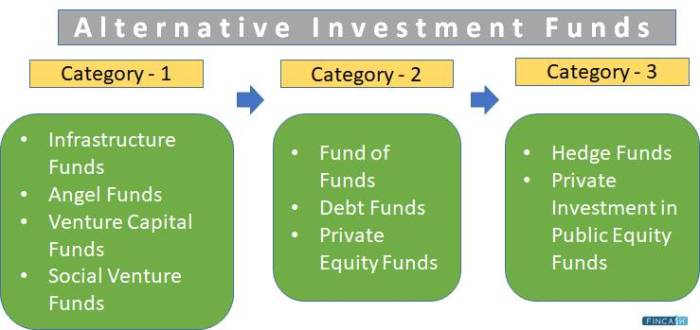
Integrating alternative investments into a comprehensive wealth management strategy offers the potential to enhance portfolio diversification, potentially improve risk-adjusted returns, and meet specific client objectives. This requires a nuanced understanding of the various alternative asset classes and their interaction with traditional assets. Careful consideration of client risk profiles and investment goals is paramount to successful implementation.
Effective strategies hinge on a thorough assessment of client needs and risk tolerance. This involves understanding their financial situation, investment objectives (e.g., capital preservation, income generation, long-term growth), time horizon, and liquidity requirements. Only then can a suitable allocation to alternative investments be determined, ensuring the overall portfolio aligns with the client’s risk profile and desired outcomes.
Alternative Investment Strategies Based on Client Profiles
Different client profiles necessitate tailored approaches to incorporating alternative investments. For instance, a high-net-worth individual with a long time horizon and high risk tolerance might comfortably allocate a significant portion of their portfolio to private equity or hedge funds seeking substantial capital appreciation. Conversely, a client prioritizing capital preservation and income generation might find a more suitable allocation in real estate or infrastructure investments, which typically offer lower volatility and stable income streams.
A balanced approach, combining elements of both strategies, might be appropriate for clients with moderate risk tolerance and diversified goals.
Asset Allocation Strategies and Risk Tolerance
The optimal asset allocation strategy varies significantly based on a client’s risk tolerance and investment objectives. A conservative investor prioritizing capital preservation might allocate a smaller percentage to alternatives, focusing primarily on lower-risk options like real estate or infrastructure. A moderate investor might diversify across a wider range of alternatives, including private debt or structured products, while maintaining a substantial allocation to traditional assets.
An aggressive investor might allocate a larger portion to higher-risk alternatives like hedge funds or venture capital, aiming for higher returns but accepting greater volatility. The allocation percentages should be determined through rigorous analysis and modelling, considering historical performance data and future projections. For example, a conservative portfolio might have 5% allocated to alternatives, while an aggressive portfolio could hold 25% or more, depending on specific circumstances and diversification within the alternative asset class.
Portfolio Construction for Specific Client Objectives
Constructing a portfolio that effectively utilizes alternative investments to meet specific client objectives requires a multi-faceted approach.
Capital Preservation
For clients prioritizing capital preservation, a portfolio might emphasize investments with lower volatility and stable returns. Real estate, infrastructure, and certain types of private debt can provide a relative degree of stability compared to traditional equities. Careful selection of these investments, focusing on established assets with strong cash flows, is critical to minimizing risk.
Income Generation
Generating a consistent income stream is a key objective for many investors. Real estate investments (through rental income), infrastructure projects (through dividends or lease payments), and private debt (through interest payments) can all contribute to a portfolio’s income generation capabilities. The specific allocation would depend on the client’s desired income level and risk tolerance.
Growth
For clients seeking significant capital growth, investments in private equity, venture capital, or certain hedge fund strategies might be considered. These investments typically carry higher risk, but also offer the potential for substantial returns over the long term. However, it is important to acknowledge that these investments are often illiquid and require a longer-term investment horizon. A successful strategy will involve a diversified approach across several alternative asset classes to mitigate risk and maximize the chances of achieving growth.
Regulatory and Legal Aspects of Alternative Investments
Navigating the world of alternative investments requires a thorough understanding of the complex regulatory and legal landscape. These regulations vary significantly across jurisdictions, impacting both the investment vehicles themselves and the responsibilities of investors. Compliance is paramount to avoid legal repercussions and ensure the smooth operation of investments.
Regulatory Frameworks Governing Alternative Investments
Alternative investments, encompassing hedge funds, private equity, real estate, and commodities, are subject to diverse regulatory frameworks depending on their nature and the jurisdiction in which they operate. In the United States, the Securities and Exchange Commission (SEC) plays a central role, overseeing the registration and reporting requirements for many alternative investment funds. The Commodity Futures Trading Commission (CFTC) regulates futures and options markets, impacting commodity-based alternatives.
Similarly, in Europe, the Alternative Investment Fund Managers Directive (AIFMD) establishes a harmonized regulatory framework for alternative investment fund managers operating within the European Union. Other jurisdictions, such as those in Asia, have their own regulatory bodies and specific rules, often influenced by international standards but tailored to their local financial markets. These regulatory bodies oversee aspects like investor protection, risk management, and disclosure requirements.
For example, reporting requirements can vary significantly; some jurisdictions may demand daily reporting for certain strategies, while others may only require quarterly or annual reporting.
Legal Considerations and Compliance Requirements for Investors
Investors in alternative assets face specific legal considerations and compliance requirements. Understanding the legal structure of the investment vehicle is crucial. Limited partnerships, for instance, have specific legal obligations for both general and limited partners. Furthermore, investors must be aware of their fiduciary duties, particularly if they are involved in the management or governance of the investment.
Sophistication requirements often exist, meaning investors must meet certain financial or experience thresholds to participate in some alternative investments, designed to protect investors who might lack the understanding of the risks involved. Compliance requirements extend to reporting obligations, adhering to anti-money laundering (AML) and know-your-customer (KYC) regulations, and understanding potential conflicts of interest. Failure to comply with these regulations can result in significant penalties, including fines and legal action.
Tax Implications of Investing in Alternative Assets
The tax implications of alternative investments can be complex and vary widely depending on the type of investment, the investor’s tax jurisdiction, and the specific investment structure. Capital gains taxes, income taxes, and potentially other taxes, such as property taxes in the case of real estate investments, can apply. The tax treatment of carried interest, a common feature in private equity and hedge fund structures, is a particularly contentious area.
Tax-efficient structures may be employed to mitigate tax burdens, but these require careful planning and professional tax advice. For example, the use of tax-advantaged vehicles like qualified opportunity funds (QOFs) in the US aims to stimulate investment in designated low-income communities while offering tax benefits to investors. Accurate and timely reporting is essential to ensure compliance with tax laws and avoid potential penalties.
Performance Measurement and Evaluation of Alternative Investments
Accurately assessing the performance of alternative investments presents unique challenges compared to traditional asset classes like stocks and bonds. The complexities arise from factors such as illiquidity, lack of standardized valuation methods, and the often opaque nature of underlying investment strategies. Consequently, a robust understanding of appropriate metrics and benchmarking techniques is crucial for effective evaluation.The inherent illiquidity of many alternative investments, such as private equity or real estate, makes frequent valuation difficult.
Unlike publicly traded securities with readily available market prices, the value of alternative assets often relies on less frequent appraisals or internal models, introducing subjectivity and potential biases into performance calculations. Furthermore, the diverse strategies employed within alternative investments, ranging from hedge funds to commodities, necessitate tailored performance metrics to capture the nuances of each approach. Simply applying traditional metrics, designed for liquid assets, can lead to misleading conclusions.
Challenges in Measuring Alternative Investment Performance
Several factors contribute to the difficulties in measuring the performance of alternative investments. Firstly, the infrequent valuation of assets leads to a lack of continuous price data, making it harder to track performance over time. Secondly, the complexity of some investment strategies can make it difficult to isolate the sources of return, making it challenging to attribute performance to specific factors.
Thirdly, the lack of transparency in some alternative investment vehicles can make it difficult to obtain accurate and reliable data. Finally, the use of leverage and other financial instruments in some alternative investments can significantly impact performance, making it difficult to compare returns across different investments.
Appropriate Performance Metrics for Alternative Investments
Several performance metrics are specifically tailored to the characteristics of alternative investments. The Time-Weighted Rate of Return (TWRR) is often preferred over the Money-Weighted Rate of Return (MWRR) because it isolates the impact of manager skill from the timing of investor cash flows. The Sharpe ratio, which measures risk-adjusted return, is widely used to compare the performance of different alternative investments, accounting for both the return and the volatility.
The Sortino ratio, a variation of the Sharpe ratio, focuses specifically on downside risk, which is particularly relevant for alternative investments that may experience significant drawdowns. Other metrics, such as the Calmar ratio (return/maximum drawdown) and the Sterling ratio (return/average drawdown), also focus on downside risk. The selection of appropriate metrics depends on the specific characteristics of the investment and the investor’s risk tolerance.
Benchmarking Alternative Investments
Benchmarking provides a crucial context for evaluating alternative investment performance. However, establishing suitable benchmarks can be challenging due to the lack of publicly available, comparable data for many alternative asset classes. Custom benchmarks, constructed using a combination of publicly traded assets and privately held investments, might be necessary. Furthermore, the benchmark’s composition should closely reflect the investment strategy’s target asset allocation and risk profile.
For example, a private equity fund focused on growth companies might be benchmarked against a growth stock index or a composite of similar private equity funds. Using inappropriate benchmarks can lead to inaccurate performance comparisons and flawed investment decisions.
Interpreting and Comparing Performance Data
Interpreting performance data for alternative investments requires careful consideration of the chosen metrics, the benchmark used, and the specific characteristics of the investment. For instance, a high Sharpe ratio indicates strong risk-adjusted returns, while a low Sortino ratio suggests significant downside risk. Comparing alternative investments to traditional asset classes necessitates adjusting for differences in liquidity, volatility, and the time horizon of the investments.
For example, a private equity fund’s performance over a 10-year period might be compared to a long-term bond index, while a hedge fund’s performance might be compared to a broader market index over a shorter time horizon. Direct comparisons should always be made cautiously, recognizing the inherent differences in risk and return profiles. Furthermore, it’s crucial to understand the limitations of historical performance data, as past results are not necessarily indicative of future returns.
Successfully integrating alternative investments into a robust wealth management strategy requires a nuanced understanding of their unique characteristics and potential risks. By carefully considering diversification, due diligence, and regulatory compliance, investors can leverage the potential benefits of these asset classes to achieve their financial objectives. Ultimately, a holistic approach that combines traditional and alternative investments, tailored to individual risk tolerance and goals, is key to building and preserving long-term wealth.
Common Queries
What are the typical fees associated with alternative investments?
Fees vary significantly depending on the investment type and manager, often including management fees, performance fees (carried interest), and other expenses. It’s crucial to understand the fee structure before investing.
How liquid are alternative investments compared to stocks and bonds?
Alternative investments are generally less liquid than traditional assets like stocks and bonds. Accessing your capital may require a longer time horizon, potentially impacting your ability to quickly sell your investment.
What is the role of a wealth manager in alternative investment selection?
A wealth manager plays a crucial role in guiding investors through the complex landscape of alternative investments. They conduct due diligence, assess risk tolerance, and construct portfolios aligned with individual client goals.
Are alternative investments suitable for all investors?
No, alternative investments are generally more suitable for sophisticated investors with a high net worth and a longer-term investment horizon due to their illiquidity and complexity.


